URL Encoder / Decoder
URLs can only safely contain a limited set of characters — everything else (spaces, symbols, non-ASCII letters) must be percent-encoded. This tool converts plain text into a valid encoded URL, and decodes encoded URLs back into readable text, in both directions.
Use the URL Encoder / Decoder now — free, no sign-up
Open the Tool →What the URL Encoder / Decoder does
Percent-encoding replaces unsafe characters with a % followed by two hexadecimal digits — a space becomes %20, for example. Query strings, API parameters, and bookmarkable links all rely on this encoding to travel across the internet without breaking. Decoding reverses the process, which is handy when debugging analytics links, UTM parameters, or API responses.
How to use it
- 1Open the URL Encoder / Decoder tool.
- 2Paste the text or URL you want to convert.
- 3Choose Encode to percent-encode it, or Decode to restore the original.
- 4Copy the result.
Key features
- ✓Both encoding and decoding in one tool
- ✓Standard percent-encoding (UTF-8) understood by all browsers and servers
- ✓Instant results with no server round-trip
- ✓Handles spaces, symbols, and non-ASCII characters
- ✓Free and unlimited
Example use case
Example: you are sharing a link that contains a search phrase with spaces and an ampersand. Encoding it produces a URL that opens correctly in every browser, instead of one that gets truncated at the first space.
Frequently asked questions
When should I encode a URL?
Whenever you place user-entered or free-form text into a URL — query parameters, share links, or API calls — encoding guarantees the URL stays valid.
Why does a space sometimes become %20 and sometimes +?
Both represent a space: %20 is standard percent-encoding used in paths and most modern APIs, while + is a form-encoding convention in query strings. This tool uses the %20 standard.
Is it safe to paste URLs with sensitive data?
The tool runs entirely in your browser, so nothing you paste is transmitted to our servers.
Related tools
JSON Formatter
Beautify, validate, and format JSON data online for free. Paste minified JSON, spot syntax errors instantly, and get clean, readable output.
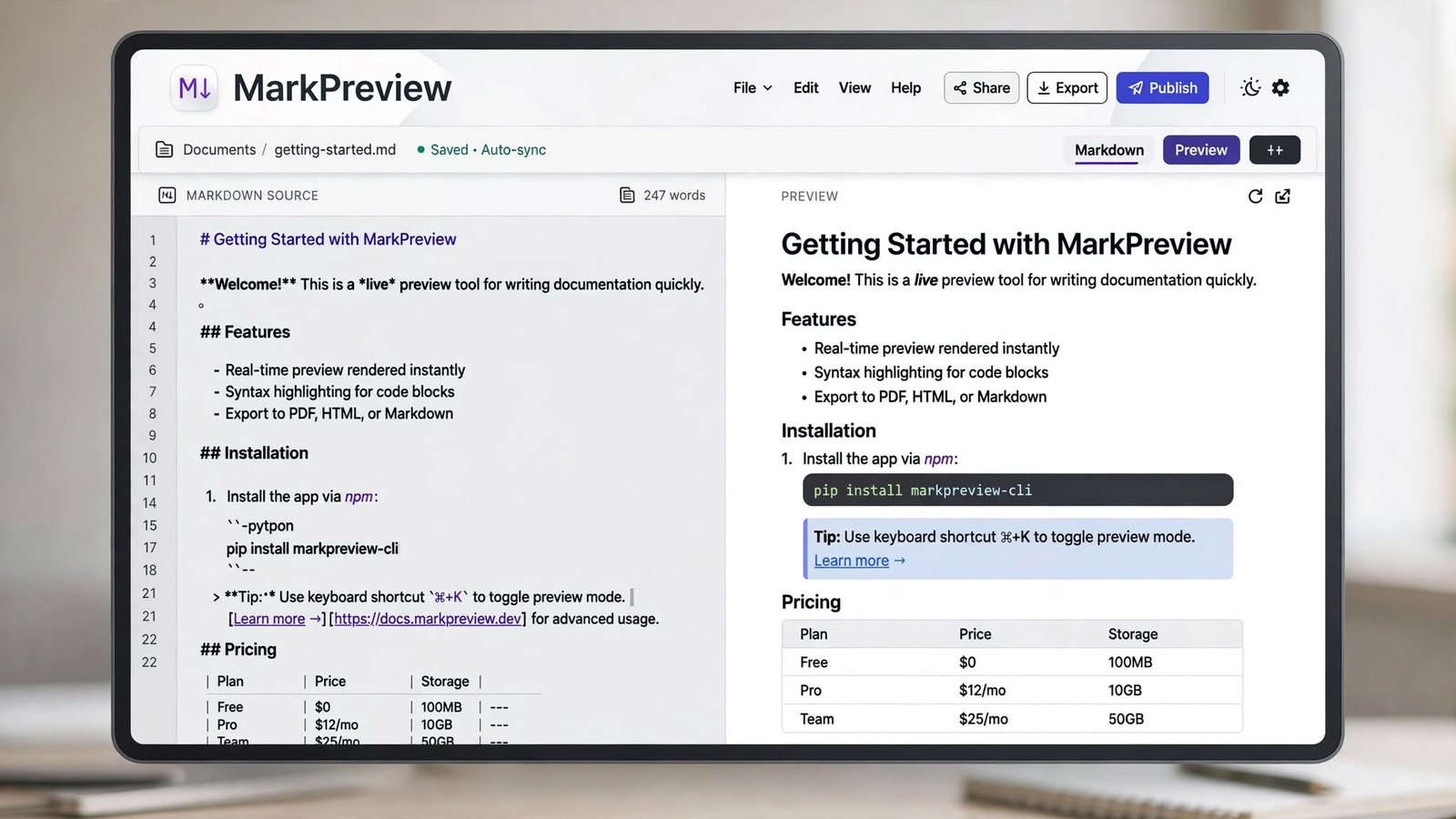
Markdown Preview
Write Markdown and see a live rendered preview side by side. Free online Markdown preview tool with headings, lists, links, code, quotes, and more.